Our story with Sally actually begins in the year 1858 (and, no, that isn’t a typo). Wen Ling left China’s Guangdong Province for San Francisco, USA. Later, he headed up to Canada, settling in the now nearly non-existent town of Port Douglas, British Columbia. During the Fraser Valley gold rush it was the second largest municipality on mainland BC. Early in 1861, Wen’s wife gave birth to a son. He was named Alexander and was the first baby to be born on Canadian soil from Chinese immigrants (that is known). What is most significant is that the birth took place six years prior to Confederation, the implications being that the British and French were not the only ethnicities who founded the country.
Nowadays, more than one-quarter of Vancouver’s citizens are ethnically Chinese, and Canada as a whole has a large population of Asian descent (13%).
Another important date in our story is 1957. The year saw the meteoric rise of Canada’s first rock ‘n roll superstar, Paul Anka. In a blacks-and-whites-only music industry in the west, most people would be surprised that, in Canada, it all began with someone of Asian descent. But, ever since the promising beginning for Asian Canadians, the music industry had failed to tap into such a pool of talent and open its doors to them.
Sally Yeh was born in Taibei, Taiwan. When she was four years old, her parents immigrated to British Columbia. She showed incredible talent for singing. After completing high school in Canada she was faced with a decision: launch a singing career in Canada or return to Taiwan to do so? Although born in Taiwan, she was Canadian: her English was better than her Chinese, she had adopted Canadian culture, and Canada was her home. Taiwan was a foreign land. Intimidated, however, by a Canadian music industry bereft of any Asian Canadian representation, she decided to venture over to the western side of the Pacific. After all, no Canadian with an Asian face could ever seriously think of becoming a singer in a country that prided itself on its diversity and multiculturalism. In Taiwan she would at least have a chance, nay an advantage.
Shortly after settling in Taibei, she was allegedly discovered by a talent scout while buying fried chicken. Yeh really wanted to sing but couldn’t pass up the opportunity to appear in a movie. This led to her signing the theme songs of several films and her securing a recording contract. There was a major problem, however. Although she could speak simple conversational Chinese (because of her parents), she couldn’t read it. How could she read and memorize song lyrics? Chinese characters were converted into pinyin romanization and large placards were held up in the recording studio as she sang into the microphone. She breathed a sigh of relief as she was asked to record some English songs in addition to the Chinese for her first album. Her debut, The Sculptures of Spring was released in 1980.
Although she was an amazing singer, the album drew little attention, as the populace wasn’t sure whether to embrace someone who wasn’t Taiwanese but Canadian and someone whose Chinese language skills were weak at best. She recorded several more albums, at least one per year but a big breakthrough eluded her. She gave up on Taiwan. In the early 80s, the music industry on the island was lagging far behind Hong Kong which was the center of the universe for the Chinese music industry. But there was an even bigger problem with her decision to relocate to Hong Kong: she couldn’t speak a word of Cantonese. Having grown up in BC, she no doubt had some Cantonese-speaking classmates, but to become a star in Hong Kong without being fluent in the dialect was a formidable challenge. She was up to the task, relocating to Hong Kong in 1984.
Working with language coaches and, again, using romanized words, she recorded the Cantonese album, Sally. The opening track, “Ten Past Midnight”, composed by George Lam was an instant hit. The song that rocketed her to superstardom came in 1987 with the release of Good Luck. Its title-track was one of the ten biggest songs of the year. The track “Dawn, Don’t Come” from the album appeared in the blockbuster film A Chinese Ghost Story and won the Best Original Song award at the 7th Hong Kong Film Awards. Sally Yeh was now rivalling local superstars Priscilla Chan and Anita Mui in popularity.
Director John Woo had gained prominence with the release of A Better Tomorrow in 1986. But he was still an unknown in the west. All that changed in 1989 when he came out with his acclaimed masterpiece, The Killer. Sally Yeh was asked to star in the film alongside Chow Yun-Fat and sing its theme songs, including “Drunk for Life“. In an interview, Yeh said, although she was glad to do the movie with Woo, she decided to drop out of acting because of the way that women were portrayed in Chinese cinema.
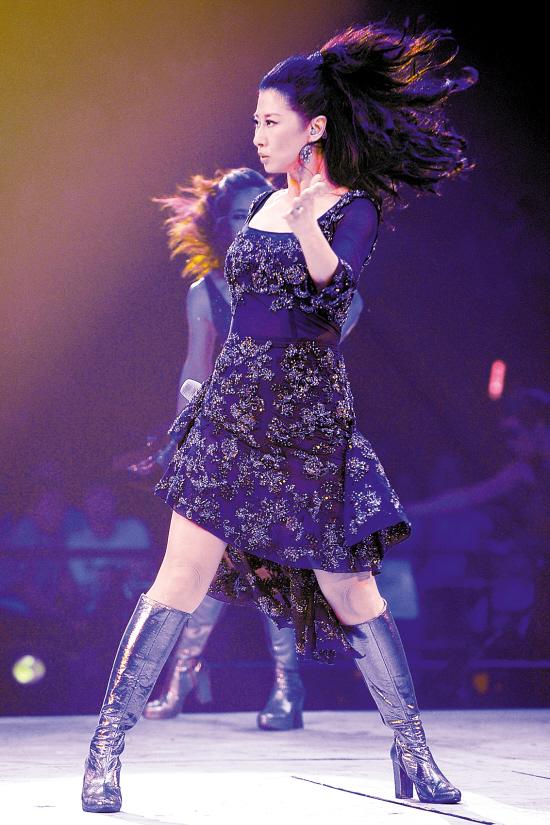
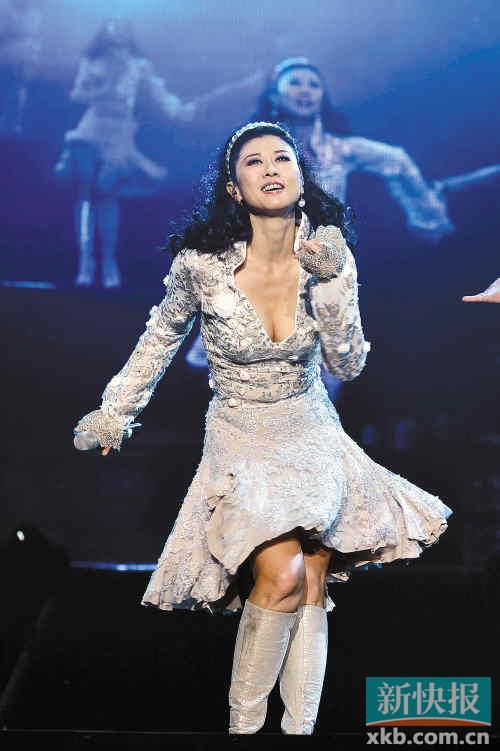
Sally had conquered Hong Kong, and now, as the decade ended, it was time to conquer the rest of China. This meant returning to Mandarin and releasing songs in both dialects. And with this, the early 90s belonged to Yeh. Her song “Walking Coolly” became the anthem of 1991, winning the Mandarin song of the year award, and she won the most popular female singer award four years in a row. Although she herself was Canadian, she came to be known as the Celine Dion of Hong Kong and developed a reputation for outdoing other singers in the Orient by staying entirely on key during live performances.
She collaborated with a couple of other western artists, recording “Dreaming of You” with Tommy Page in 1992 and “I Believe in Love” with James Ingram the following year.
In the mid-90s, when she married George Lam, Yeh’s popularity gradually diminished despite appearances from Sammi Cheng, Anthony Lun, and Jackie Chan on her records. The couple lived in Canada and bought a house in San Francisco. After recording a Chinese version of Celine Dion’s “My Heart Will Go On” in 1998, she took a break from making records. In 2002, however, she made a triumphant comeback with the album You Heard and hit single “Mourning“. She followed up with Inside Out in 2003. She now had 30 studio albums under her belt. On January 7th, 2011, Yeh was awarded the prestigious Lifetime Achievement Golden Needle Award in Hong Kong.
While Canadians celebrate their singers’ success abroad, this is normally only true for achievement in the United States. Success by Canadian artists in other countries, like China, France, even Britain, is rarely acknowledged. We acknowledge Sally Yeh as one of the finest and most successful Canadian singers the world has ever seen.
Canadian Music Blog | June 10, 2011